Blog

People development is not a luxury – it is project risk management

Lisa-harrison.png

By Lisa Harrison - Learning and Leadership Consultant

Lisa Harrison is a Sydney-based learning and development consultant and founder of The Learning Pyramid, where she helps project managers and technical experts make the shift from ‘doing’ to truly leading. She specialises in practical, evidence-based programs that turn project managers into confident people leaders who can engage stakeholders, motivate teams, and deliver results. Her flagship Certificate in Project Leadership focuses on the human side of projects – lifting team performance, reducing burnout, managing tricky stakeholders, and boosting project outcomes. If you would like to hear more about the skills for leading successful projects, you can connect with her at www.thelearningpyramid.com or at https://www.linkedin.com/in/lisajharrison/


It is time to debunk the myth that ‘there is no time for people development on
projects’.

I get it. Projects move fast, deadlines loom, and your status reporting is a sea of red and orange. So when someone suggests spending time developing your team, the reflex response is often: ‘Are you kidding me? We barely have time to deliver what we promised.’ Sorry to break it to you, but skipping development usually creates more risk, not less.

Single-point-of-failure people (and unexpected lottery winners)

From a risk perspective, you need more than one person with any critical skill on your project. What happens when your star developer gets a better offer? Or your key analyst wins the lottery? (Hey, it could happen.) 
Suddenly you are scrambling with no backup plan. That is not just inconvenient – it is a textbook single-point-of-failure risk that could have been mitigated with some deliberate cross-skilling.

I have watched projects wobble because too much knowledge lived in one person’s head. When that person left, got sick, or simply burned out, the beautiful Gantt chart quietly turned into a work of speculative fiction. Or the gorgeous Kanban board had a distinct lack of weight on the right hand side!

Development as a mid-project retention strategy

Quite likely, your high performers did not become high performers by accident. They love to learn and stretch; they get energy from mastering new things. If your project offers them nothing but repetitive tasks and last-minute fire-drills, they get restless. Then they get curious about what other organisations are offering. 
Houston we have a problem. Guess who you definitely do not want walking out the door mid-project?

Investing in development sends a clear message: ‘You matter. You are valued.’ That is not fluffy HR talk; it is a serious retention strategy and a very cost-effective risk control.

See the whole human, not just the resource

On a recent holiday, I was reminded how powerful small gestures are. I did what I always do when I travel – learned a few basic phrases in the local language.

Languages are soooo not my superpower, so the pronunciation was… let us call it ‘creative’. But when I greeted people in their language, everything shifted. Whether it was the person carrying bags, the taxi driver, or the shop assistant, you could see a light appear in their faces. In a very small way, but they felt seen as whole people, not just as someone providing a transaction.

The same thing happens in projects – even more so when we feel seen by our managers and leaders. When leaders know people’s stories, strengths, and pressures outside work, the relationship shifts. Emotionally intelligent leaders who connect with people as humans – not just as lines on a resource plan – are the ones getting that extra discretionary effort every project desperately needs.

Practical ways to build development into delivery

The good news is that embedding development does not require a six-month leadership program. Although of course that will help, there are small steps you can implement straight away. You can build it into the work you already have to do. For example:

  • Stretch assignments – Do not always give a task to the person who can do it fastest. Sometimes give it to someone who will take longer because it is their first time. 
  • Shadowing and pairing – Let a less experienced team member shadow a ‘star’ on a critical piece of work, then reverse the roles on something lower risk.
  • Internal show-and-tell – Run short, informal teach-back sessions where team members demo what they have built, or share a trick they have learned.
  • Rotating roles – Rotate chairs in stand-ups, showcases, risk workshops etc. so more people build confidence and visibility.

None of this slows the project down anything like as much as scrambling to replace a single-point-of-failure person halfway through.

People development is not something you squeeze in if there is time left over (spoiler alert: there is never time left over). It is the work – and it is very smart risk management, cleverly disguised as people leadership.

What sort of development are you offering to your team? Is it solely focussed on tech skills when we know that people skills – ‘power skills’ are so key to the project’s success? Who on your team might be getting bored or lacking in stretch assignments that float their boat?

I’d love to hear your thoughts on development in project teams – the good the bad and the ugly. Hit me up at https://www.linkedin.com/in/lisajharrison or This email address is being protected from spambots. You need JavaScript enabled to view it.

Why Quiet Professionals Struggle to Be Heard And How to Change That

Niamh-OBrien.PNG

Insights from Niamh O'Brien's Quiet Power Workshop | September 29, 2025

Your expertise is solid. You've earned your place at the table. But when it's time to speak up in that meeting, pitch your idea, or advocate for yourself—something stops you.

You're not alone. And here's the good news: the skills to communicate with quiet confidence are completely learnable.

Last week, Niamh O'Brien—communication coach and former management consultant—shared her journey from socially anxious and barely able to speak, to becoming a top-performing industry leader. Her secret? Learning to engage with her whole self: how she speaks, shows up, and carries herself with authenticity.

Click to download the slides from the workshop in here:

NOBrien_Unlock-Your-Quiet-Power_250925-PMI-NSW.pdf

The Four Pillars of Quietly Powerful Communication

Niamh broke down her framework into four actionable areas that any professional can apply immediately:

1. Know Yourself and Others

Communication starts with self-awareness. When you understand how you speak best—and recognize patterns in others—everything shifts. People listen more. You connect better.

The key question: When do you feel most comfortable speaking? Identify those conditions and recreate them intentionally.

2. Conversational Mastery

Your voice changes when you're nervous. It might speed up, get quieter, or lose steadiness. But small adjustments create massive impact.

Niamh's practical tips: Pause before answering. Speak slightly slower. Use simple, clear words. Think through your main point first. These micro-changes help you sound calmer and more assured—even when pressure's high.

3. Personal Presence Activation

Here's what most people miss: your body language communicates before you say a word. How you sit, whether you make eye contact, your facial expressions—they all signal confidence.

Choose 2–3 qualities you want others to notice (confident, approachable, credible) and show them through your physical presence.

4. Be Your Own Champion

Under pressure, patterns emerge: talking faster, speaking quietly, forgetting your point, looking down. Recognize these in yourself.

Then build your pre-conversation toolkit: deep breaths, one prepared question, practicing key points out loud. Small preparations create relaxed, ready confidence.

Take These Skills Further

If you've ever felt like your expertise outshines your ability to communicate it, Niamh's created something specifically for you.

Download her free workbook: "Become a Quietly Powerful Communicator" walks you through reflection questions and practical exercises for each of the four pillars. It's designed to help you take meaningful steps starting immediately.

[Download the Workbook Here]

For those ready to go deeper, Niamh offers the Quiet Power Pathway—an 8-week hybrid program combining self-paced modules with live coaching. You'll get personalized feedback on your vocal delivery from a professional actor, plus six one-on-one coaching sessions where you'll work through real challenges in a judgment-free space.

The program includes:

  • 4 self-paced modules with short videos (3-15 min each)
  • 30 minutes/week for exercises
  • 75-minute live coaching sessions every two weeks
  • Personalized vocal feedback and techniques you can rely on

Your Next Step

You don't need to become someone you're not. You need skills that work with who you already are.

Start with the workbook. Reflect on the questions. Apply one small change this week.

Your expertise deserves to be heard. Let's make sure it is.

Download Niamh's Free Workbook

Quietly-Confident-Communication-Formula_workbook-0925.pdf


Want to connect with Niamh? Visit NiamhOBrien.au or reach out to explore how the Quiet Power Pathway can transform your communication.

Making Project Governance Work

Adrian-Morey.jpeg

By Adrian Morey

Adrian is a globally recognised Project, Program and Portfolio Governance (P3G) expert, market-leading advisor, international speaker, and co-author of the best practice P3G Guide.  He helps organisations deliver strategic outcomes with clarity, confidence, and control. From ensuring investments contribute meaningfully to strategy, to establishing or uplifting governance frameworks and ways of working across projects, programs, and portfolios, he brings practical insights and deep expertise to create the conditions for sustained success and value. With over 30 years advising on projects, programs, and portfolios across infrastructure, technology, and transformation — and sectors including transport, health, water, energy, government, and more — he brings pragmatic solutions and a global perspective to every engagement. He’s passionate about bridging strategy, delivery, and outcomes to drive measurable impact and uplift in performance. He regularly speaks at global forums — including PMI, IPMA, and DIPMF — on evolving governance trends and the future of sponsorship. His work is grounded in better practice, real-world experience, and a deep understanding of what makes governance succeed (or fail).


Missed our August 13th event? You can still catch the key insights!

At Making Project Governance Work: Real-World Solutions for Executives, PMs and PMOs, we explored why governance is often the hidden factor that determines project success—or failure. In today’s fast-moving environment, fewer than 55% of projects globally meet their objectives, and unclear decision-making, fuzzy accountabilities, and weak oversight are frequently to blame.

In this engaging session, Adrian shared practical, real-world solutions for building governance that actually works. From fit-for-purpose frameworks to actionable tips, Adrian showed how to create governance arrangements that keep projects on track and deliver strategic value.

Now you can access the slides and resources from the event—so whether you’re an executive, project manager, or PMO leader, you can put these proven approaches into practice.

�� Catch the slides below.

Why P3 Governance is Important

Strong governance across projects, programs, and portfolios (P3) is critical to ensuring that strategic investments deliver their intended value. Without clear decision-making, effective oversight, and robust accountability, even well-planned initiatives can falter—often at great cost.

Industry research underscores the scale of the challenge:

  • Standish Group CHAOS Report (2020): Only 31% of projects were deemed successful (delivered on time, on budget, and with satisfactory results), while 19% failed outright—either cancelled or never used.
  • PMI Pulse of the Profession (2021): Organisations waste an average of 11.4% of their project investment due to poor performance.
  • McKinsey & Company (2023): Just 30% of large-scale transformations succeed, a figure consistent with long-standing benchmarks.
  • Boston Consulting Group (2020): Around 70% of digital transformation initiatives fail to achieve their intended goals.

These figures highlight a consistent reality: without effective P3 governance, organisations risk wasted resources, missed opportunities, and strategic setbacks. Governance provides the framework, processes, and accountability needed to steer initiatives toward success—turning strategic intent into measurable results.

Captura-de-pantalla-2025-08-14-181825-11.png

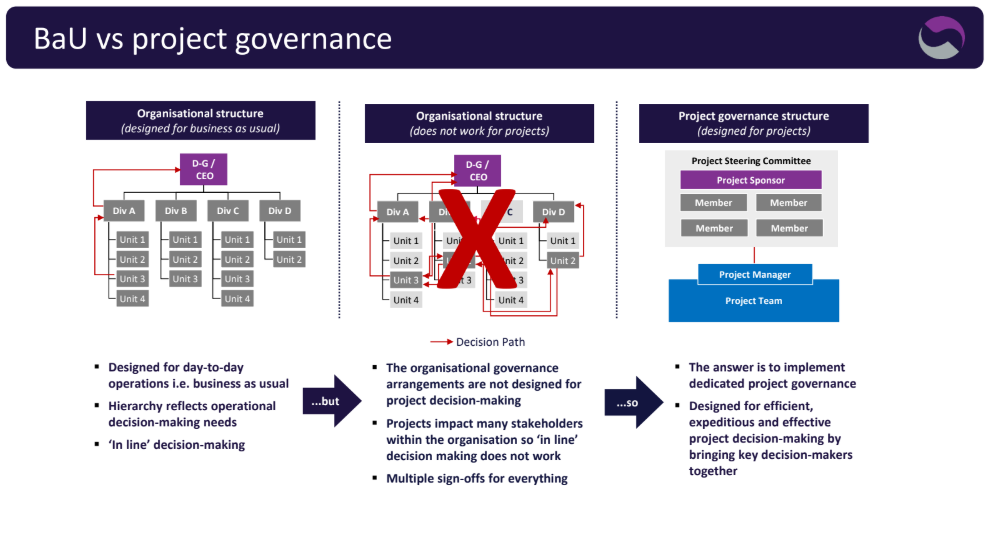
Project governance vs. project management

Captura-de-pantalla-2025-08-14-182008-22.png

Captura-de-pantalla-2025-08-14-182142-33.png

Captura-de-pantalla-2025-08-14-182625-44.png

Captura-de-pantalla-2025-08-14-182646-55.png

Captura-de-pantalla-2025-08-14-183246-66.png

Captura-de-pantalla-2025-08-14-183306-77.png

Captura-de-pantalla-2025-08-14-183325-88.png

Captura-de-pantalla-2025-08-14-183342-99.png

Captura-de-pantalla-2025-08-14-183441-00.png

Captura-de-pantalla-2025-08-14-183500-111.png

Captura-de-pantalla-2025-08-14-184135-222.png

Captura-de-pantalla-2025-08-14-184204-333.png

The PMI Sydney Blog

Real-World Solutions for Executives, PMs and PMOs

Making Project Governance Work

Explore why strong project, program, and portfolio (P3) governance is critical to success. Learn about common pitfalls and risks in P3 governance, and discover how the P3G Guide’s principles and practical guidance can help overcome these challenges. Find out how to take the next steps in your P3 governance journey.

 Read Post

 Screenshot111


 quiet

Why Quiet Professionals Struggle to Be Heard and How to Change That

Unlock Your Quiet Power

Your expertise means nothing if you can't communicate it—and no, you don't need to become an extrovert to be heard. Communication coach Niamh O'Brien went from barely able to speak to industry leader, and she's sharing the exact four-pillar framework (plus a free workbook) that makes quiet professionals impossible to ignore.

Read Post


People Development is not a Luxury – It is Project Risk Management

It is time to debunk the myth that ‘there is no time for people development on projects’.

 Read Post

 Screenshot111